
I. Introduction: The Quality Check
Measuring lead generation effectiveness involves tracking and analyzing a series of metrics—beyond simple form submissions—to determine the efficiency, cost, and ultimate profitability of leads generated through digital marketing campaigns.
In the competitive Indian market, getting a lead is easy; getting a good lead is hard. Businesses need to know they aren’t paying for junk data that just wastes their sales team’s time. Understanding the true metrics of lead success ensures your agency is driving real business growth, not just filling your inbox with low-quality inquiries.
Key Takeaway: True lead generation effectiveness is not measured by volume, but by the Cost Per Qualified Lead (CPQL) and the conversion rate from a Marketing Qualified Lead (MQL) to a Sales Qualified Lead (SQL).
II. Why Do Businesses Waste Money on Low-Quality Leads?
Direct Answer: Businesses waste money on low-quality leads because they prioritize the Cost Per Lead (CPL) metric over the much more critical metric of lead quality, leading to high sales team frustration and budget drain.
This fundamental misunderstanding—prioritizing volume over value—is where marketing budgets often get wasted. Don’t let your business fall into these common traps:
- The “Cheap Lead” Trap: An agency reports a very low CPL (e.g., ₹50), making the campaign look successful. However, 95% of those leads are unqualified (wrong region, wrong budget, fake details), wasting hundreds of hours of valuable sales time.
- Lack of Sales Alignment: Marketing and Sales teams often don’t agree on what a “good” lead is. This means the agency optimizes campaigns to the wrong standard, delivering what they think is right, not what the sales team can actually close.
- Ignoring Follow-Up Time: They only measure the lead source, not the time it takes the sales team to close that lead (Lead Velocity), missing bottlenecks in the process or failing to credit fast-closing campaigns.
- No CRM Integration: The agency fails to integrate tracking all the way to the Customer Relationship Management (CRM) system, making it impossible to see which marketing campaigns actually resulted in a sale—the true ROI.
III. Core Sections: Measurement & Quality
What Are the Essential Metrics to Track Lead Generation Success in Digital Campaigns?
The essential metrics to track lead generation success in digital campaigns move past clicks and forms to focus on efficiency and qualification, providing a clear pathway from initial interest to final purchase.
Direct Answer: The most essential metrics are Cost Per Lead (CPL), Lead Volume (by channel), Conversion Rate (CVR), and the crucial progression from MQL (Marketing Qualified Lead) to SQL (Sales Qualified Lead).
- Key Success Metrics:
- Cost Per Lead (CPL): Total ad spend divided by the number of raw leads generated. Always compare this to the Cost Per Qualified Lead (CPQL).
- Lead Volume by Source: Identifying which platforms (Google Search, Facebook, LinkedIn) generate the highest volume of leads to guide budget allocation.
- Lead-to-Opportunity CVR: The percentage of leads that sales accepts and moves into the active sales pipeline (the first step toward revenue).
- Time-to-Conversion: How quickly a lead converts into a paying customer, which helps predict sales team performance and cash flow.
- Return on Investment (ROI): The final measure: total revenue generated from the leads versus the total marketing cost spent to acquire them.
How Do Agencies Measure Lead Quality and Conversion Performance Effectively?
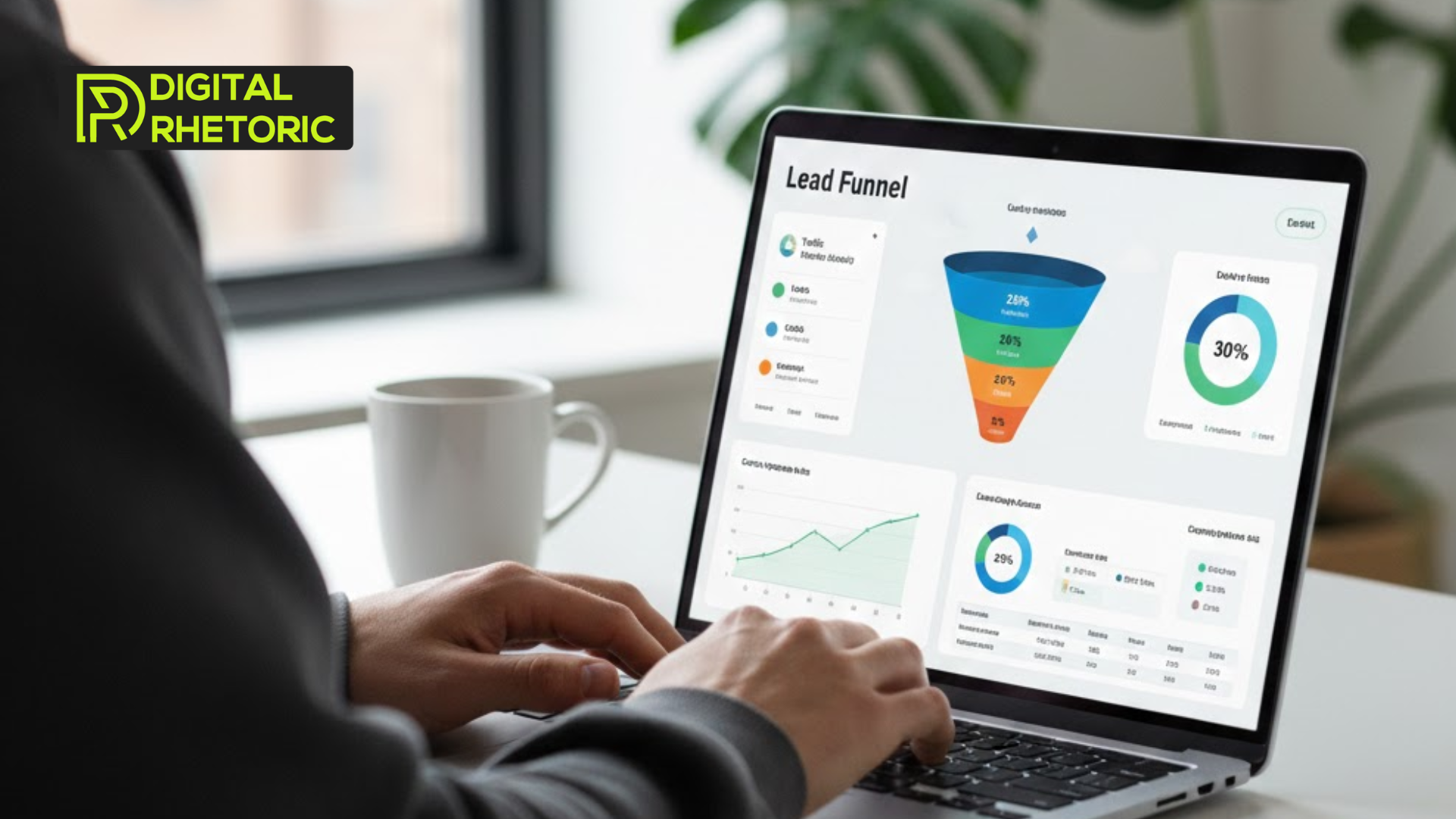
Direct Answer: Agencies measure quality by applying a Lead Scoring model and closely tracking the drop-off rates between different stages of the sales funnel.
- Lead Scoring: This system assigns points to leads based on their actions (e.g., visited pricing page +5 points; downloaded whitepaper +3 points). Leads reaching a high score are automatically deemed Sales Qualified Leads (SQLs) and instantly flagged for sales follow-up.
- Funnel Drop-Off: A good agency analyzes where leads are lost. If leads are high quality (high score) but fail to convert after the first sales call, the problem is sales, not marketing, defining clear boundaries of responsibility.
What Lead Tracking and Analytics Tools Used by Marketing Agencies Are Essential?
The lead tracking and analytics tools used by marketing agencies must ensure a seamless flow of data from the initial ad click directly into the client’s sales pipeline, establishing a single source of truth for attribution.
Direct Answer: Essential tools include a robust CRM system, integrated Google Analytics 4 (GA4) setup, and powerful call/form tracking software for end-to-end visibility.
- Essential Technology Stack:
- CRM System (e.g., Salesforce, Zoho, HubSpot): The mandatory hub where all leads are scored, assigned, and tracked through every sales stage, regardless of the marketing channel.
- Google Analytics 4 (GA4): Used for micro-conversions, behavioral tracking, and confirming ad platform data on your website.
- Server-Side Tracking (Conversions API): A more reliable method than relying solely on browser cookies, especially important for Meta/Facebook tracking in India where ad blockers are common.
- Call Tracking Software: For businesses relying on phone calls, this links the exact phone number and campaign to the lead’s final status.
- Heatmap & Session Recording Tools (e.g., Hotjar): Used to see exactly why visitors are abandoning lead forms, revealing friction points on your landing pages.

Why Is CRM Integration the Most Important Step in Lead Generation?
Direct Answer: CRM integration is the most important step because it closes the feedback loop, allowing the agency to optimize based on revenue generated, not just form submissions.
Without CRM integration, the agency only sees MQLs (Marketing Qualified Leads). When the CRM is linked, the agency can see which campaigns produce the highest percentage of SQLs (Sales Qualified Leads) and, more importantly, closed deals. This linkage is the difference between a guessing game and a data-driven strategy. It transforms the agency from a cost center into a profit partner.
IV. Local Insights and Examples
How Do Agencies Adapt Lead Measurement for the Indian Market?
Direct Answer: Agencies adapt lead measurement for the Indian market by heavily integrating conversational platforms like WhatsApp and tracking regional lead characteristics, which often differ significantly from metro to Tier 2 cities.
- Local Focus Points:
- WhatsApp/Chatbot Integration: Measuring leads generated through WhatsApp Business APIs, which often have higher intent but require different tracking parameters than standard web forms.
- Language Segmentation: Tracking the CPL and CPQL specifically for campaigns run in regional languages (e.g., Telugu, Marathi) to prove the viability of vernacular marketing.
- Lead Velocity in Regional Hubs: Analyzing if leads from major centers like Bangalore or Delhi convert faster than those from smaller cities like Jaipur or Ahmedabad, helping the sales team prioritize follow-up.
- Case Example: A finance company’s agency discovered that their lowest CPL came from Facebook Forms, but their highest SQL rate (30% better) came from their dedicated Google Search ads, despite a higher CPL. They shifted budget to the higher-cost, higher-quality Google ads, proving the value of measuring quality over volume.
V. Conclusion
True lead generation effectiveness is a science, not guesswork. By demanding transparency on CPQL and MQL-to-SQL rates, and insisting on full CRM integration, you empower your agency to optimize for profit, not just volume.
Ready to move beyond vanity metrics and implement robust lead tracking and analytics tools used by marketing agencies to grow your revenue? Let’s discuss a data strategy today.