
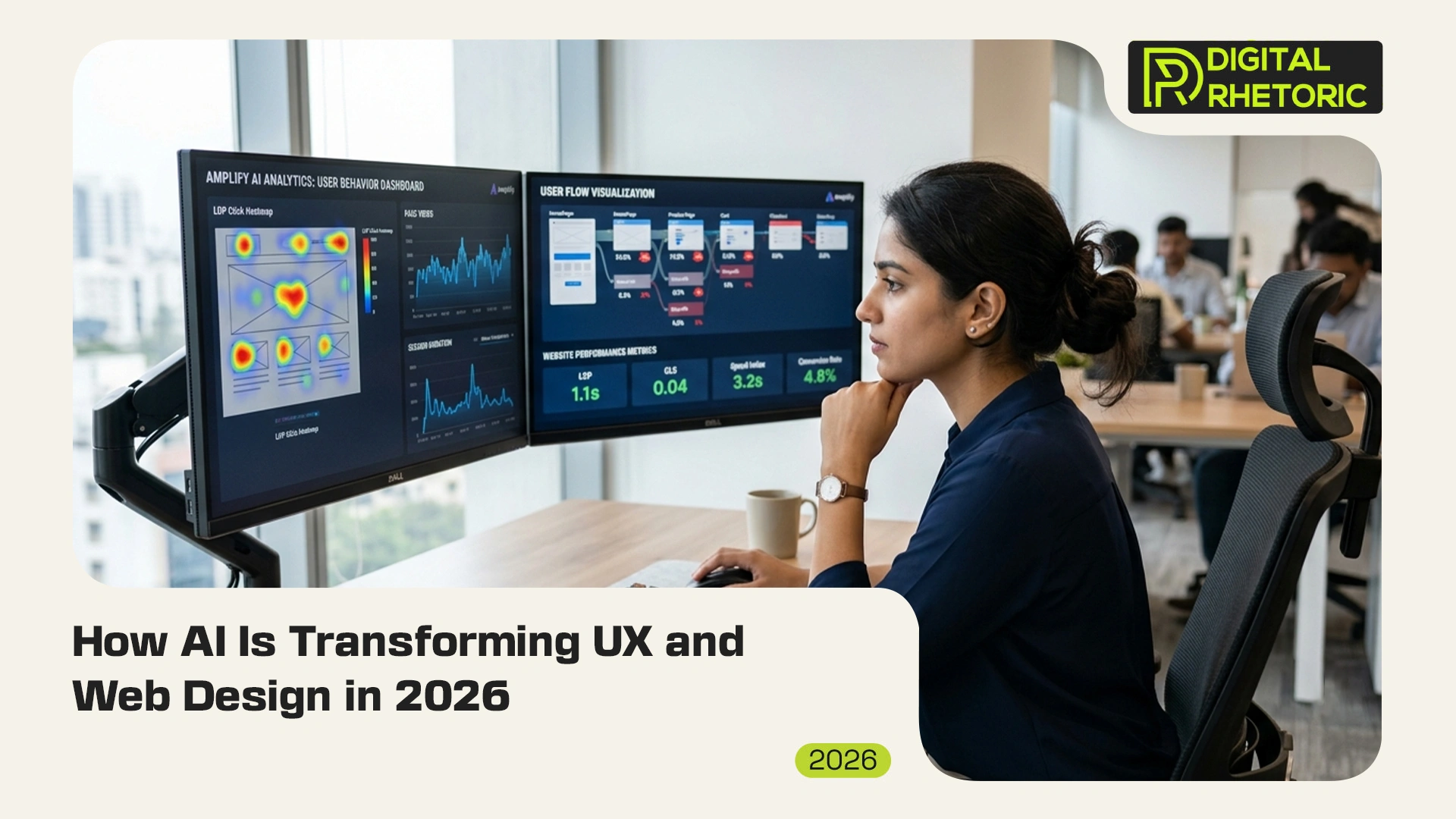
Not long ago, designing a website involved weeks of research, wireframing, user testing, revisions, and development. Today, a designer can generate layouts, analyze user behavior, predict conversion bottlenecks, and personalize experiences with the help of artificial intelligence in a fraction of the time.
This shift is changing how businesses approach digital experiences. Companies are no longer competing solely on design aesthetics. They are competing on how effectively their websites understand users, anticipate needs, and guide visitors toward meaningful actions.
The rise of AI in UX design is transforming everything from user research and content personalization to interface creation and conversion optimization. Businesses that embrace these changes are creating faster, smarter, and more user-centric digital experiences. Those that ignore them risk falling behind as customer expectations continue to evolve.
In this article, we explore the biggest AI web design trends 2026, explain the future of UI UX with artificial intelligence, and share practical strategies businesses can use to improve user experience, engagement, and conversion rates.
What Is AI in UX Design?
AI in UX design refers to using artificial intelligence to improve how websites are designed, personalized, tested, and optimized for users.
Rather than relying entirely on manual research and assumptions, AI helps designers make data-driven decisions.
AI can support:
- User behavior analysis
- Interface recommendations
- Personalization engines
- Automated testing
- Content optimization
- Accessibility improvements
The goal is not to replace designers but to help them create better experiences more efficiently.
Why Is AI Becoming Important in Web Design?
Modern users expect fast, relevant, and personalized digital experiences. AI helps businesses meet those expectations at scale.
As websites become more complex, AI helps teams process large amounts of user data and identify patterns humans might miss.
Benefits include:
- Faster decision-making
- Better user experiences
- Higher engagement rates
- Improved conversion performance
- Reduced design guesswork
Businesses that use AI effectively can continuously improve their websites based on real user behavior rather than assumptions.

How Is AI Transforming UX and Web Design?
AI is changing every stage of the design process, from research to optimization.
AI-Powered User Research
Traditionally, user research takes significant time and resources.
AI now helps by:
- Analyzing visitor behavior patterns
- Identifying friction points
- Detecting navigation issues
- Predicting user intent
This allows designers to uncover insights much faster.
Personalized Website Experiences
AI enables websites to adapt based on individual users.
Examples include:
- Personalized product recommendations
- Dynamic content delivery
- Customized calls-to-action
- Tailored landing pages
Visitors receive experiences that feel more relevant to their needs.
Automated Design Suggestions
AI design tools can generate layouts, design concepts, and interface recommendations based on project goals.
These tools help teams:
- Build prototypes faster
- Test multiple design variations
- Improve workflow efficiency
Designers remain in control while AI accelerates production.
Smarter Conversion Optimization
AI can identify where users drop off and recommend improvements.
This helps businesses:
- Increase form submissions
- Improve checkout completion rates
- Reduce bounce rates
- Enhance lead generation
The result is a website that not only looks good but performs better.

Benefits of AI in UX Design
AI improves both business outcomes and user satisfaction.
Key advantages include:
Better User Experiences
AI helps websites respond to user needs more accurately.
Benefits include:
- Faster navigation
- More relevant content
- Improved usability
- Better customer satisfaction
Faster Design Processes
Design teams spend less time on repetitive tasks.
AI helps automate:
- Layout generation
- Content recommendations
- Data analysis
- User testing insights
This accelerates project timelines.
Increased Conversion Rates
Websites that understand visitor behavior tend to perform better.
AI supports:
- Personalized user journeys
- Optimized page layouts
- Smarter calls-to-action
- Better lead capture processes
Mini Case Study: AI-Powered UX Improvements
A B2B software company noticed that website traffic remained steady, but lead generation was declining.
The team implemented AI-powered analytics tools to study user behavior.
The analysis revealed:
- Visitors struggled to find pricing information
- Important calls-to-action were buried
- Mobile users encountered navigation friction
After redesigning those elements based on AI-generated insights, the company experienced:
- Higher engagement rates
- Improved lead form submissions
- Lower bounce rates
- Better overall user satisfaction
The redesign focused on user behavior rather than assumptions, which made the difference.

Best Practices for Using AI in UX Design
The most successful websites combine artificial intelligence with human creativity and strategic thinking.
Consider these best practices:
- Use AI to analyze user behavior regularly
- Test multiple design variations
- Personalize content where appropriate
- Maintain consistent brand identity
- Prioritize accessibility and usability
- Continuously monitor user feedback
AI should support decision-making, not replace it.
Conclusion
The future of UI UX with artificial intelligence is not about replacing designers. It is about creating smarter workflows, more informed decisions, and better user experiences. AI allows businesses to understand visitors more deeply, personalize interactions more effectively, and continuously improve website performance based on real-world behavior.
As digital experiences become increasingly competitive, businesses that adopt AI-driven UX strategies gain an important advantage. They can move faster, respond to customer needs more accurately, and create websites that deliver stronger business results.
At Digital Rhetoric, we combine AI-powered insights with strategic UX design, conversion optimization, SEO, and performance-focused development. Our goal is simple: build websites that not only attract visitors but convert them into customers.
Want to know whether your website is ready for the next generation of AI-powered user experiences? Schedule a Website Performance Review with Digital Rhetoric and discover opportunities to improve engagement, conversions, and growth.