
A few years ago, searching online meant typing a few keywords into Google and scrolling through ten blue links. People compared websites, opened tabs, and spent time finding answers themselves.
Today, the behavior already starts changing.
A business owner asks an AI assistant, “What is the best CRM for a growing company?” Instead of ten websites, they receive a summarized answer. A student asks for explanations and receives conversational responses instantly. A marketer asks complex questions and gets recommendations in seconds.
Search no longer looks the same.
The debate around Claude AI vs Google search comparison grows because users increasingly prefer faster, contextual answers instead of manually filtering information. Traditional search engines still dominate online discovery, but AI-powered tools now influence how users research, compare, and make decisions.
The question is no longer whether AI affects search.
The real question becomes: who owns the future?
In this article, we explore AI search vs traditional search engines, compare strengths and weaknesses, analyze current trends, and understand the future of search with AI tools.
What Is Claude AI vs Google Search?
Claude AI and Google Search solve information discovery differently. Google helps users find sources. Claude helps users understand answers.
The distinction matters.
Google Search focuses on:
- Website indexing
- rankings and search intent
- discovering multiple sources
- links and references
Claude AI focuses on:
- conversational answers
- summarized insights
- contextual responses
- interactive information discovery
The experience feels very different.
Why Does This Matter for Businesses?
Search behavior changes customer journeys. Businesses must adapt to how people discover information.
Discovery now expands beyond websites.
Modern users increasingly use:
- AI assistants
- conversational search tools
- voice interfaces
- instant recommendation systems
Visibility becomes more complex.

Benefits of Traditional Search Engines
Google remains powerful because it offers breadth, authority, and choice.
Users still want control.
Advantages include:
- Access to millions of sources
- website traffic opportunities
- local search functionality
- product discovery
Google remains highly effective for intent-based searches.
Benefits of AI Search Tools
AI search tools simplify discovery by reducing effort and providing immediate understanding.
Speed creates value.
Benefits include:
- conversational experiences
- summarized information
- follow-up interactions
- contextual recommendations
The experience often feels easier.
Claude AI vs Google Search Comparison
Both systems solve different problems rather than replacing each other completely.
Here is a practical comparison:
Google Search
Strengths:
- Massive information index
- real-time discovery
- local search capabilities
- shopping and transactional results
Weaknesses:
- Information overload
- multiple clicks required
Claude AI
Strengths:
- conversational responses
- faster understanding
- context retention
- summarized answers
Weaknesses:
- limited direct browsing behavior
- depends on information sources
Different use cases create different winners.
The Future of Search With AI Tools
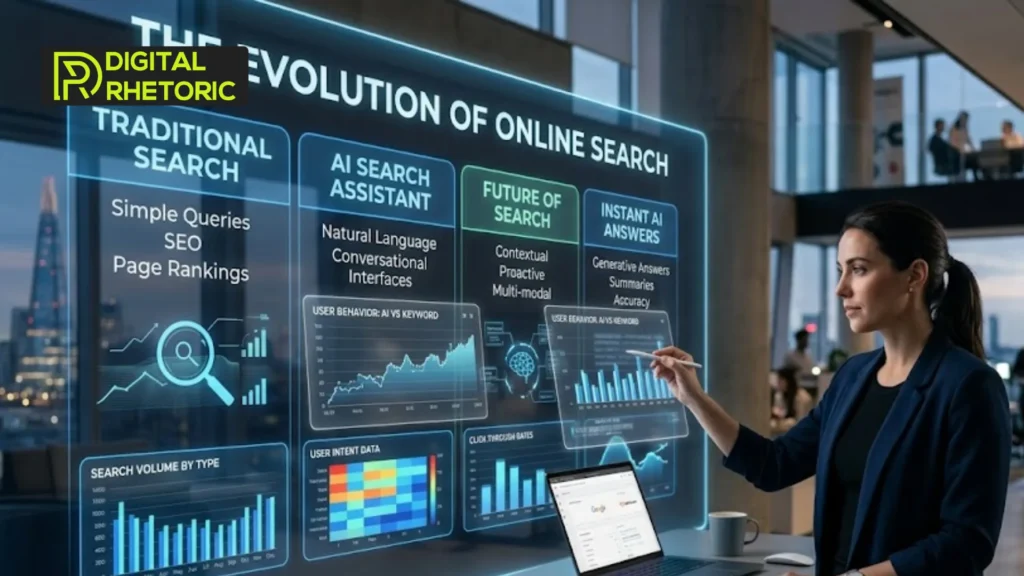
Search increasingly moves toward blended experiences combining traditional and AI systems.
Search evolution already appears visible.
Examples include:
- AI-generated summaries
- conversational search interfaces
- voice-based interactions
- personalized recommendations
Search increasingly becomes assistance rather than navigation.
Mini Case Study: How User Behavior Already Changes
A marketing team researches project management software.
Previously the process looked like this:
- Google search
- opening multiple websites
- reading reviews
- comparing features manually
Now many teams begin differently.
They ask AI tools:
“Compare project management platforms for remote teams under specific budgets.”
The workflow becomes faster.
Users still verify sources afterward, but AI significantly reduces initial research effort.
The pattern suggests that AI changes how discovery begins rather than completely replacing search engines.
How Businesses Should Adapt
Businesses should prepare for visibility across both traditional search and AI-assisted discovery.
Relying on one channel creates risk.
Recommended steps:
Build topical authority
Focus on:
- helpful content
- expertise signals
- FAQs
- structured information
Strengthen brand recognition
AI systems often surface recognized entities.
Build:
- mentions
- reviews
- authority content
Create answer-focused content
Content increasingly performs better when structured clearly.
Include:
- direct answers
- concise explanations
- question-based headings

Think beyond rankings
Future visibility extends beyond classic search positions.
Businesses should optimize for:
- search visibility
- AI discoverability
- brand recall
Conclusion
The discussion around Claude AI vs Google search comparison often assumes there will be one winner.
Reality appears more nuanced.
Traditional search engines still provide depth, authority, and discovery power. AI tools increasingly simplify information processing and reduce friction for users.
The future of search with AI tools likely combines both experiences rather than replacing one entirely.
Businesses that prepare early gain an advantage. Visibility no longer depends only on rankings. It increasingly depends on discoverability across multiple ecosystems.
Digital Rhetoric operates as an AI-first SEO and performance partner, helping brands build visibility strategies designed for both search engines and emerging AI environments.
Want to know if your brand is ready for AI-driven discovery?
Book a search visibility audit with Digital Rhetoric and uncover where your business stands in the future of search.