
Have you noticed that search results no longer look the same?
Instead of ten blue links, users now see answers, summaries, and recommendations.
AI-assisted discovery layers in Google Search shape decisions instantly.
This shift changes how people discover brands. Ranking first is no longer the only goal, being quoted, summarized, or recommended by AI matters more.
This is where new terms enter the conversation.
SEO, AEO, and GEO often sound confusing or interchangeable.
Many businesses ask the same questions.
Is SEO still relevant?
What is answer engine optimization?
Do GEO strategies replace everything else?
This article explains what actually works for AI-driven search results.
You will understand GEO vs SEO, AEO vs SEO, and how they work together.
You will also learn practical AI search optimization strategies that help brands stay visible.
Everything stays simple, structured, and business-focused.
What Is SEO, AEO, and GEO?
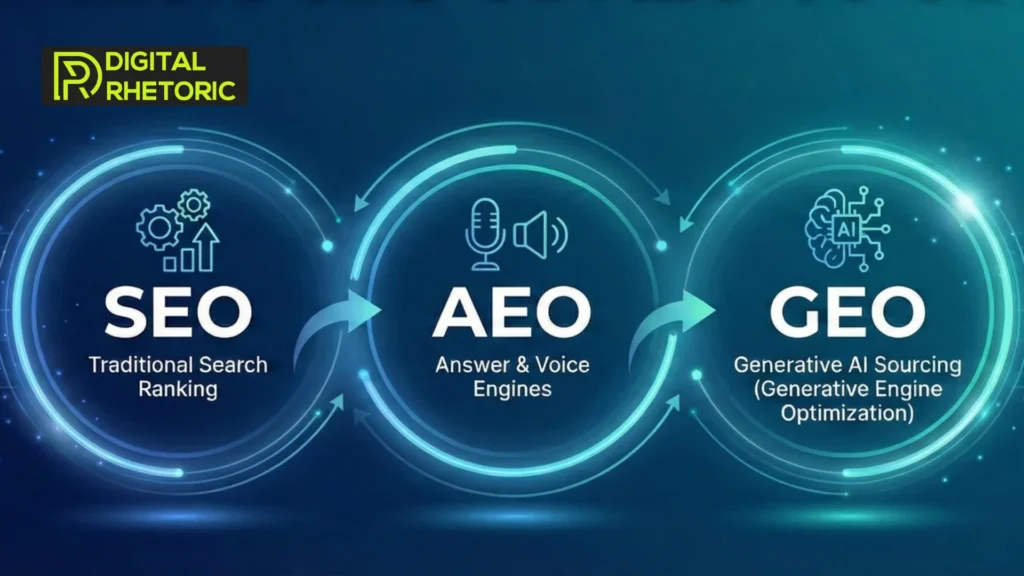
SEO, AEO, and GEO serve different roles in AI-driven search.
They are not competing strategies.
They are complementary layers.
What is SEO?
SEO focuses on ranking pages in traditional search results.
It helps search engines understand relevance and authority.
Key SEO elements include:
- Keywords and intent
- Technical performance
- Backlinks and trust signals
SEO still builds the foundation.
What is AEO (Answer Engine Optimization)?
Answer engine optimization focuses on direct answers.
It optimizes content for featured snippets and AI summaries.
Core AEO practices include:
- Clear question-based headings
- Short, direct answers
- FAQ-style formatting
This supports visibility in AI-generated responses.
What is GEO (Generative Engine Optimization)?
GEO optimizes content for AI-generated summaries and recommendations.
It focuses on how AI compiles and presents information.
GEO strategies emphasize:
- Contextual completeness
- Entity clarity
- Structured explanations
This is critical for modern AI search.

Why GEO, AEO, and SEO All Matter Now
AI-driven search engines use all three layers together.
They do not replace SEO with GEO or AEO.
Instead, they combine them.
Reasons this matters:
- AI pulls from ranked pages
- AI prefers clear answers
- AI summarizes complete topics
Understanding GEO vs SEO helps brands adapt intelligently.
Benefits of Using SEO, AEO, and GEO Together
A combined approach improves visibility and trust.
It covers how users search today.
Key benefits include:
- Visibility in Google AI Overviews
- Better performance in conversational AI search tools
- Stronger topical authority
- Long-term search resilience
This approach reduces dependency on rankings alone.
Steps That Actually Work for AI-Driven Search
How should businesses approach SEO today?
SEO should focus on intent, not just keywords.
Pages must answer real user questions clearly.
Effective SEO practices include:
- Intent-based keyword usage
- Clean site structure
- Internal topic clusters
This supports AI discovery.
How does AEO improve AI visibility?
AEO improves how content gets extracted by AI.
It makes answers easy to identify.
Key AEO steps include:
- Writing FAQ-style sections
- Placing answers immediately after questions
- Using simple, precise language
This supports answer engine optimization.
How do GEO strategies support AI summaries?
GEO helps AI generate accurate summaries.
It ensures content is complete and understandable.
Effective AI search optimization strategies include:
- Covering topics end-to-end
- Explaining concepts, not just listing facts
- Using structured sections and examples
This improves selection by AI systems.
Real-World Example: What Works in Practice
A B2B services website ranks outside the top three results.
Despite this, it appears consistently in AI summaries.
Why it works:
- Strong SEO foundation
- Clear AEO-style answers
- Context-rich GEO formatting
AI prefers clarity over position.
This example highlights AEO vs SEO in action.
SEO supports discovery.
AEO and GEO drive visibility.

How AI Search Platforms Use Content
AI platforms combine ranking, answers, and context.
Examples include:
- Google AI Overviews summarizing multiple sources
- Conversational AI search tools responding to natural questions
These platforms prioritize:
- Clear explanations
- Trustworthy sources
- Structured information
This makes integrated optimization essential.
Conclusion
AI-driven search reshapes how brands gain visibility.
SEO builds discoverability.
AEO improves answer extraction.
GEO ensures AI summarizes content correctly.
Understanding GEO vs SEO and AEO vs SEO helps businesses stay competitive.
Ignoring any layer weakens results.
AI search optimization strategies work best when integrated.
They support Google AI Overviews and conversational AI search tools together.
Digital Rhetoric operates as an AI-first SEO partner.
We help brands adapt to how search actually works today.
If you want your business to appear in AI-generated answers, not just rankings, now is the time.
Contact Digital Rhetoric for an AI search readiness audit and strategy consultation.