How to Generate Unique Logo Concepts That Truly Reflect Your Brand Identity
You know your business better than anyone. You can articulate your vision, your mission, and your unique value proposition in your sleep. But when it comes to creating that one simple, powerful visual—the logo—your mind goes blank.
You look at iconic Indian brands—the simple yet powerful TATA ‘T’ or the universally recognized State Bank of India (SBI) keyhole—and you wonder: How did they distill their entire legacy into one small mark? When you try, all you seem to get are generic stock icons and uninspired designs.
The big question every entrepreneur faces is: How do you translate the soul of your business into a simple, powerful visual mark that sticks? This post is your roadmap. We’re breaking down the exact steps to move you from confusion and generic ideas to a focused, unique logo concept that resonates deeply with your target customers.
The Danger of Generic

Getting your logo wrong doesn’t just result in a design that looks okay; it actively hurts your business, especially in the crowded and competitive Indian market.
The cost of settling for generic is high:
- Lost Recognition: If your logo looks like everyone else’s, customers scrolling through social media or search results won’t remember you. You become noise, not signal.
- Weak Differentiation: A generic logo fails to communicate what makes you special. If you’re using a literal handshake for “trust” or a leaf for “sustainability,” you’re relying on tired clichés that your audience ignores.
- Wasted Time & Money: A quick, cheap fix now leads inevitably to an expensive, urgent redesign later when your brand starts scaling and you desperately need a proprietary identity.
The Cliché Trap: Your brand is too special, too nuanced, and holds too much original value to be represented by clip art. Whether you are aiming for reliability like a good national bank or vibrance like a regional festival, your brand needs an original story. Let’s find it.
The Foundation (The Brand First Rule)
The logo design journey starts with words, not drawings. Before you touch a pencil or a design tool, you must define your identity’s DNA.
1. The Adjective List
Create a list of 5–10 core adjectives that describe the feeling and values of your brand. Ask yourself: “If my brand were a person, what 10 words would describe its personality?”
Adjective Category | Example Adjectives |
Tone | Trustworthy, Playful, Serious, Elegant, Bold |
Style | Modern, Minimalist, Heritage, Geometric, Organic |
Value | Reliable, Accessible, Exclusive, Dynamic, Caring |
Tip for the Indian Market: Ground your adjectives in local context. What does ‘reliability’ look like in Mumbai? What does ‘vibrance’ mean in a Delhi context? Use those local associations to inform your adjectives.
2. Know Your Customer (The Who)
Your logo is not for you; it’s for your ideal customer. If your audience consists of young, hip students in Delhi who spend time on Instagram, your logo should look wildly different than one targeting traditional, established business owners in Mumbai. Understanding your target demographic’s aesthetic preferences is crucial.
Mantra to Live By: “A great logo is simple, memorable, versatile, and appropriate.” Use this four-point checklist as a benchmark for every idea you generate.
Idea Generation (Creative Brainstorming Techniques)
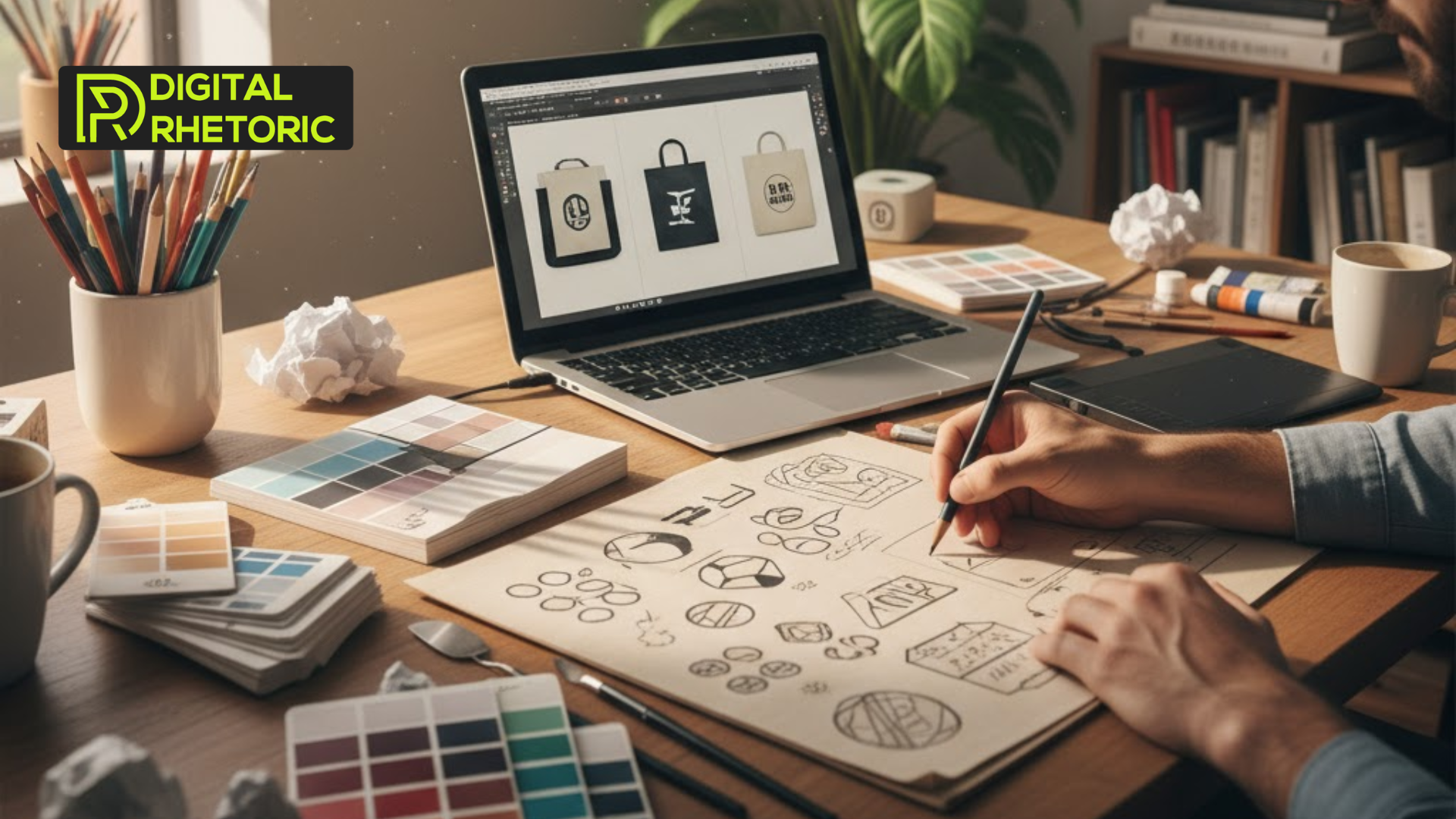
This is where you actively generate logo design ideas that break away from obvious, overused visual concepts.
3 Creative Logo Brainstorming Techniques for Unique Concepts:
- Mind Mapping Magic (The Association Game)
- Technique: Put your central brand keyword (e.g., “Financial Consulting”) in the middle of a page.
- Draw branches for related, abstract concepts (e.g., Trust, Growth, Security, Future).
- Extend those branches with concrete symbols, animals, or objects that represent them (e.g., ‘Security’ → ‘Vault’, ‘Shield’, ‘Mountain Peak’).
- This technique helps uncover surprising and unique logo concepts that are not literal, but symbolic.
- The ‘Opposite Day’ Drill (Standing Out)
- Technique: Analyze your main competition. If every rival in your industry uses the colour blue and a round, soft shape (the common cliché), try something intentionally different, like green or deep purple and a sharp, geometric shape (the opposite).
- Goal: This is critical for standing out, whether your logo is displayed in search results, on a banner, or on social media. Differentiation is the first step to memorability.
- Black and White First (Testing Concept Strength)
- Technique: Design without color. Only sketch and refine your concepts using pure black and white.
Goal: If your logo works perfectly in monochrome, it means the concept and the shape are strong. If the design relies heavily on a splash of color to make sense or be recognized, the underlying idea is weak and will fail when reproduced on a black-and-white printout or a single-color backdrop.
Sketching and Selection (Old-School Method)

The fastest and best way to generate logo design ideas is not on a computer, but with a pen and paper.
The Power of Quantity
- Don’t Aim for Perfection: Don’t aim for the perfect sketch—aim for 50 ideas in an hour. Even the bad, sloppy ideas serve a purpose, often acting as a bridge to good ones. Remember: The famous Nike Swoosh was created for only $35! Simplicity and volume lead to breakthroughs.
- The Mashup Method: Once you have a high volume of sketches, stop and analyze them. Take one element you like from Sketch 5 (a geometric angle), one from Sketch 18 (a hidden symbol), and one from Sketch 42 (a particular curve) and combine them. This is how you create fresh, proprietary, and unique logo concepts that feel inspired.
The Final Filter: 3 Questions for Selection
Once you have narrowed your selection down to 3–5 solid ideas, put them through a final quality check to ensure your design truly reflects your brand’s DNA:
- Is it easy to describe to a child? (Tests simplicity and memorability.)
- Does it look good when shrunk down to a tiny size? (Tests versatility, especially for profile pictures and app icons.)
Does it still feel authentic to your brand’s DNA (your adjective list)? (Tests appropriateness and brand alignment.)
Conclusion
Designing a logo that successfully tells your brand’s story requires stepping back from the pressure of drawing and focusing first on your brand story. By diligently using these creative logo brainstorming techniques, you can move past generic clip art and confidently approach a designer with clear, inspired, and actionable unique logo concepts.
Ready to transform those simple, high-potential concepts into a stunning visual identity that attracts customers across India? We specialize in bridging the gap between your brand’s strategy and its striking visual execution. Let’s make your logo iconic.
FAQ Section – Logo Concept Development
Q1. How can I generate logo design ideas that are unique and brand-focused?
Start by defining your brand’s personality using descriptive adjectives, then apply creative logo brainstorming techniques like mind mapping, competitor analysis, and sketching in black & white. This process helps you generate logo design ideas that are original, meaningful, and aligned with your brand identity.
Q2. What are the best creative logo brainstorming techniques for standout concepts?
The most effective techniques include mind mapping abstract ideas, using the “opposite approach” to avoid industry clichés, and rapid sketching to explore multiple directions. These methods encourage innovative thinking and lead to truly unique logo concepts.
Q3. Why do unique logo concepts matter for brand identity?
Unique logo concepts help your brand stand out, improve recall, and communicate your core values instantly. They prevent visual similarity with competitors and establish a strong, memorable brand presence across digital and offline platforms.
Q4. How do I avoid generic symbols when generating logo design ideas?
Avoid overused icons by focusing on symbolism rather than literal representation. Use local cultural references, brand emotions, and visual metaphors to create distinctive visuals that support creative logo brainstorming techniques.
Q5. What steps ensure my logo truly reflects my brand personality?
Test your final logo against three criteria: simplicity, scalability, and alignment with your brand adjectives. If it communicates your brand story clearly and remains effective at any size, it represents a strong and unique logo concept.